

Maybe you noticed Hannover on a flight connection, got a trade-fair invite, or spotted it on a train map. Now you’re wondering if it’s worth your time. That’s understandable. Hannover is known as a city people pass through, not one they usually stop to see, and it hasn’t tried to change that image. But there’s something that often surprises visitors, and it might surprise you too. Hannover is one of the few cities where your walking route is painted right on the street, so you can look around instead of checking your phone. All the main sights are close together in a neat, flat loop, and you can see everything at a relaxed pace. One good day is truly enough, and this guide says how to make it count.
What Is the Red Thread in Hannover?
The Red Thread, or Roter Faden in German, is just what the name suggests: a red line painted on the pavements of Hannover. Since the early 1970s, it has quietly helped visitors find their way, and it’s a great reason to spend a day here.
- The route is 4.2 km long and forms a loop, connecting 36 numbered sights throughout the old town and city centre.
- It begins and ends at the main station, right at Ernst-August-Platz.
- You can buy a small booklet in several languages at the Tourist Information office across from the station. There’s also an app available.
There’s no need to book anything. Just look for the big number 1 painted outside the Tourist Information in Hannover, Germany, and you’re ready to start. The line guides you along the way, making it perfect for a first visit.
How Do You Spend a Day Along the Red Thread?

Think of it as a relaxed morning walk followed by a leisurely lunch, leaving your afternoon free. You can see the main sights in three to four hours at an easy pace, or take a full day if you want to linger. Here’s what a typical day looks like along the thread in Hannover.
Where you are | What's in front of you | Why it's worth the pause |
Early: Opera House | A grand 19th-century theatre on Opernplatz | Grab your first coffee here before the crowds |
Mid-morning: New Town Hall | The palace-like Neues Rathaus from 1913 | The curved lift and four city models live here |
Late morning: Leineschloss & Nanas | The riverside parliament, then bold curvy sculptures | Niki de Saint Phalle's 1974 figures, right on the Leine |
Noon: Old Town | Half-timbered lanes around the Marktkirche | The oldest, prettiest pocket of the city |
Lunch: Markthalle | A covered food market from the 1950s | The best-value feast on the whole route |
Afternoon: Kröpcke | The central square and its landmark clock | Where locals say "meet you at the clock" |
One stop you won’t forget is the New Town Hall. Step into the main hall for free and you’ll see four scale models of Hannover from 1689, 1939, 1945, and today. The 1945 model, showing the city flattened by wartime bombing, sits next to the modern version and sums up Hannover’s story in just half a minute.
Next, check out the lift. Hannover is home to the world’s only curved dome lift. It starts by going straight up, then tilts to a 17-degree angle to follow the dome’s curve, taking you to a gallery near the 97.7-metre top. On a clear day, you can see all the way to the Deister ridge and even the Harz hills. The lift usually runs from spring to autumn and depends on the weather, so make sure to check before planning your visit.
Tribe Travel Tip: Take the dome lift first, not last. Seeing Hannover from above at the start helps you make sense of the rest of the Red Thread, and the line is shortest in the morning.
What Should You Eat Along the Way in Hannover?

Plan your walk so you reach the Markthalle at lunchtime. Locals affectionately call it "Hannover's Belly." Since the 1950s, it has brought together sausages, cheeses, fresh bread, seafood, and street food from around the world. Grab a seat, order at the counter, and take in the city scene.
Here are a few things you should try while you're in Hannover:
- Grünkohl: This dish features curly kale served with a local spicy sausage. It's a hearty favourite in Lower Saxony during autumn and winter.
- Spargel: In spring, white asparagus is served, often with hollandaise sauce, ham, or schnitzel.
- Welfenspeise: This local dessert is a two-layer pudding made of white vanilla cream and yellow wine cream. It's named after the former ruling House of Welf.
- Leibniz butter biscuits: These are Hannover's most famous export. Bahlsen created them in the 1890s and named them after the city's renowned philosopher, Gottfried Wilhelm Leibniz.
Here's a story you can share while enjoying your biscuit. In 2013, someone dressed as the Cookie Monster stole a 20 kg gilded Leibniz-biscuit sign from the Bahlsen headquarters and asked for free biscuits for children. The sign was later found hanging around the neck of a horse statue. That playful mix of mischief and civic pride is very much in the spirit of Hannover.
Is Herrenhausen Gardens Worth Leaving the Thread for?
If you have half a day free, definitely go. The Herrenhausen Gardens are a few kilometres northwest and not on the Red Thread, so people in a rush often overlook them.
- The Great Garden (Großer Garten) is one of the best-kept baroque gardens in Europe. It was designed in the late 1600s by Electress Sophia, who once said, "the garden is my life."
- Be sure to see the grand fountain, the hedge maze, the open-air theatre, and a jewel-like grotto redesigned by Niki de Saint Phalle.
- You can take a tram from the city centre and be there in about 20 minutes, making it easy to fit into an afternoon in Hannover.
When Is the Best Time to Visit Hannover?
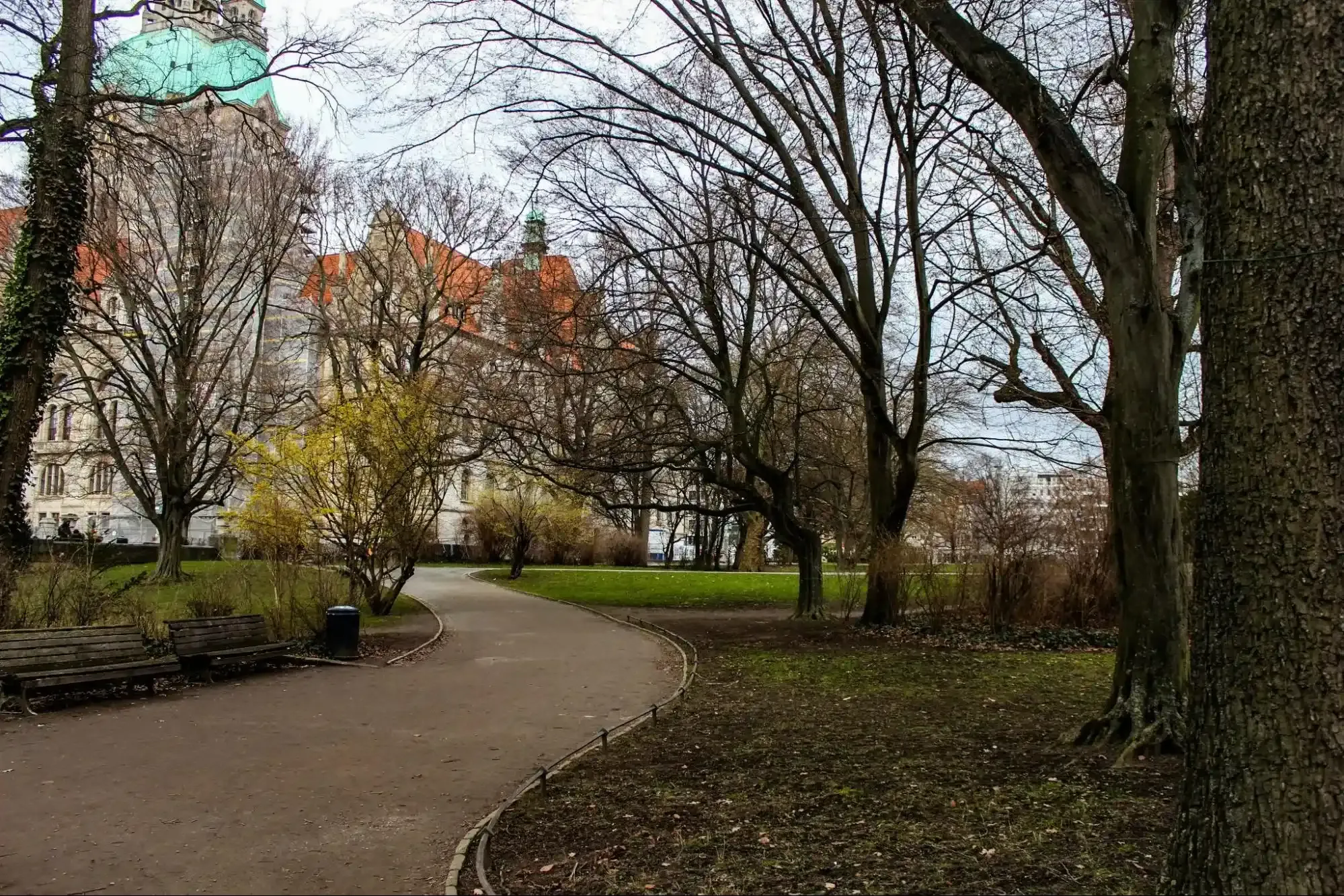
Hannover has a mild, oceanic climate with gentle summers, gray and damp winters, and rain spread out across the year. For this walk, try to visit between late May and mid-September, when the days are long and warm.
Here’s a quick look at Hannover’s weather to help you pack appropriately.
Season | Months | Typical daytime temp | What it feels like |
Spring | Mar–May | 8–18°C | Fresh and changeable, the odd cold snap in April |
Summer | Jun–Aug | 22–25°C | Warmest and brightest, ideal for the loop |
Autumn | Sep–Nov | 8–18°C | Crisp, festival season, proper Grünkohl weather |
Winter | Dec–Feb | 2–5°C | Cold, damp, short days, occasional snow |
Hannover’s warmest month is July, with daytime highs between 22 and 25°C. January is the coldest, usually around 2 to 5°C during the day and often dropping below freezing at night. Sometimes, summer temperatures soar much higher, like in July 2022, when the city reached a rare 39°C.
Tribe Travel tip: Hotel prices in Hannover go up a lot during major trade fairs. If you have flexible dates, check the fair calendar and try to avoid those weeks for a quieter visit and better rates.
How Do You Get to Hannover and Around the City?

Hannover Airport (code HAJ) is about 11 km north of the city centre in Langenhagen, and getting into town is easy.
- The S-Bahn line S5 runs directly from beneath the terminal to the main station in about 17 or 18 minutes.
- Trains leave about every 30 minutes, starting early in the morning and running until after midnight. Tickets cost just a few euros.
- Taking a taxi is faster to arrange but costs more, usually between €25 and €50.
There are no direct flights from India to Hannover, Germany. You will need to connect through a European or Gulf hub like Frankfurt, Munich, Dubai, Doha, or Istanbul. Once in Germany, Hannover is a major high-speed rail hub, so taking an ICE train from another German city is often easier.
In the city centre, you will hardly need to use public transport. The Red Thread walking route is easy to follow from start to finish, and trams can take you to places further away, like Herrenhausen.
Ready to Put Hannover on Your Map?
Hannover might not seem flashy at first, but it has a way of surprising you. You can follow the red line, ride a leaning lift, enjoy lunch at the market, and stroll through a royal garden, all in one day and all on foot. Hannover also fits perfectly into a bigger holiday around Germany, since it’s right between Hamburg, Berlin, and the Harz.
This is where our holiday advisors can help. At Holiday Tribe, we plan land-only holidays in Germany and Europe, arranging your hotels, transfers, sightseeing, and local experiences before you arrive. If you want a holiday through Germany, we have ready-made options. If you prefer to choose your own cities and gardens, our advisors will create a plan that matches your travel style. Just tell us your dates and what kind of holiday you want, and we’ll handle the rest.