

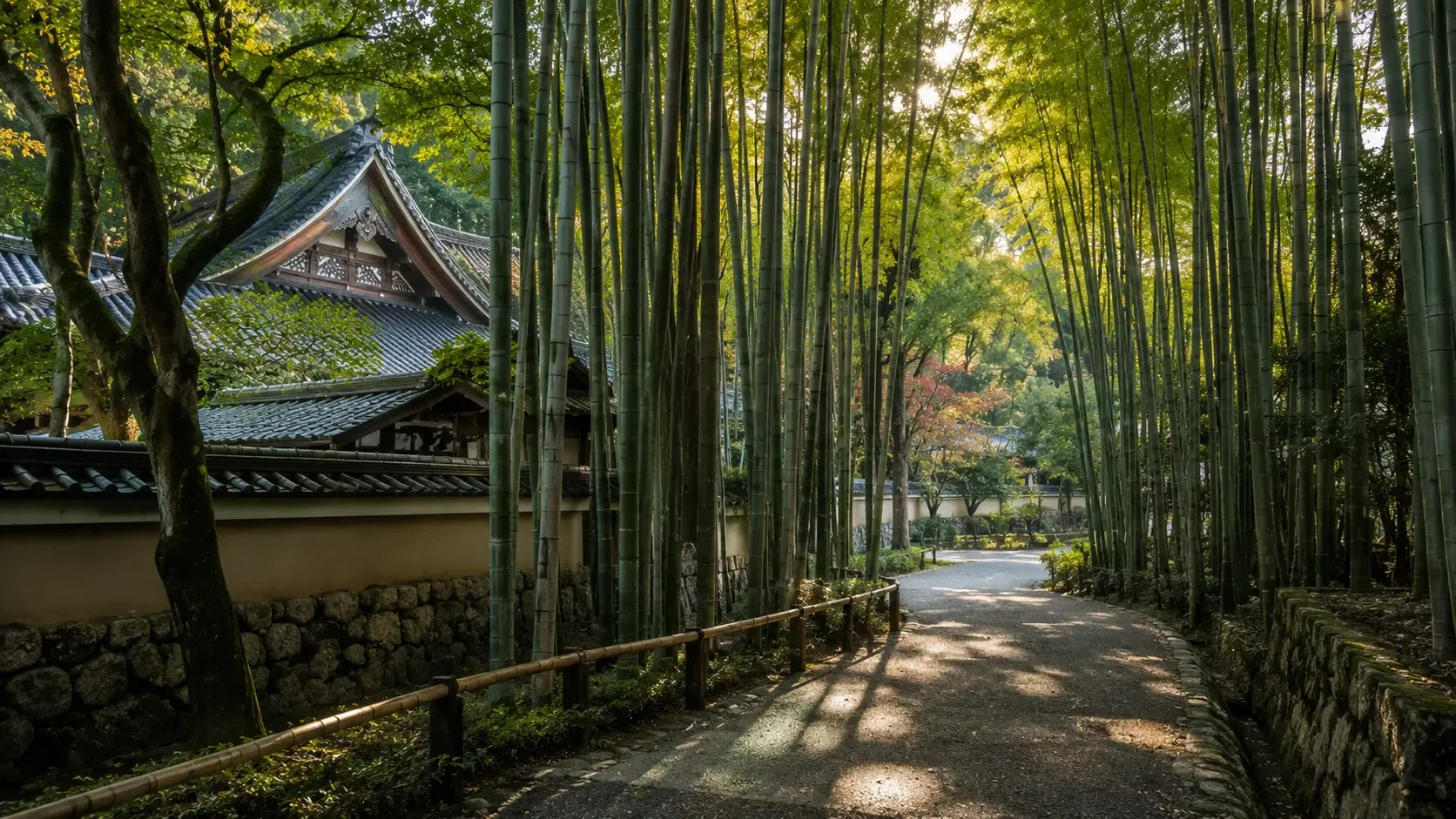
Arashiyama is a district in western Kyoto known for its river views, temple gardens, and the tall bamboo along the Sagano Bamboo Path. The Arashiyama Bamboo Grove is always open and free to enter. The 400-metre path winds through bamboo stalks that can reach 25 metres high, creating a canopy that blocks much of the sky. The sound of wind in the bamboo has been named one of Japan's 100 Soundscapes by the Ministry of the Environment.
This guide covers the Arashiyama Bamboo Grove's history, entrance fee, opening hours, the best times to visit, how to get there, and things to do nearby.
What Is the Arashiyama Bamboo Grove?
The Arashiyama Bamboo Grove in Japan is a public walking path through thick moso bamboo (Phyllostachys edulis) in the Sagano area of western Kyoto. Its official Japanese name is Chikurin no Komichi, meaning "Bamboo Path." The path stretches about 400 metres between Tenryu-ji Temple and Okochi Sanso Villa.
The bamboo stalks can reach up to 25 metres tall and are packed so closely that the canopy covers most of the sky above the path. In 1996, Japan's Ministry of the Environment named the sound of wind in the bamboo as one of the country's 100 Soundscapes, a special list for sounds that are part of Japan's natural and cultural heritage.
Detail | Information |
Official name | Chikurin no Komichi (Bamboo Path) |
Path length | 400 metres |
Bamboo height | Up to 25 metres |
Entrance fee | ¥0 (free) |
Opening hours | 24 hours a day, 365 days a year |
Ministry designation | One of Japan's 100 Soundscapes (1996) |
The City of Kyoto manages the Arashiyama Bamboo Grove, which welcomes several million visitors each year.
What Is the Arashiyama Bamboo Grove History?
The Arashiyama Bamboo Grove history stretches back to the Heian period (794 to 1185 CE), when the area became a retreat for Kyoto's aristocrats. Its forested hills, river views, and bamboo-covered slopes made it one of the most prized landscapes near the imperial capital.
Emperor Kameyama, who ruled from 1260 to 1274, is linked to bamboo cultivation in Arashiyama. He often stayed in the area and valued the bamboo landscape as part of the district's natural beauty.
Tenryu-ji Temple was founded in 1339 by Shogun Ashikaga Takauji, with Zen master Muso Soseki as its first abbot. The temple and its garden, which uses the mountain scenery as a backdrop, helped shape the area's character and drew lasting attention to Arashiyama. Tenryu-ji became a UNESCO World Heritage Site in 1994.
For much of its Arashiyama Bamboo Grove history, the bamboo served practical purposes alongside aesthetic uses. Moso bamboo was used for basket weaving, as food (bamboo shoots are still a seasonal Kyoto delicacy), and as building material in the region.
The walking path that visitors use today was set up as a tourist route in the 20th century. Before then, most people could only reach the bamboo through temple grounds or private estates.
Period | Event | Significance |
Heian (794-1185) | Arashiyama becomes aristocratic retreat | Bamboo established as part of cultural landscape |
1260 to 1274 | Emperor Kameyama cultivates bamboo in the area | Historical royal association with the grove |
1339 | Tenryu-ji Temple founded by Shogun Ashikaga Takauji; Muso Soseki appointed founding abbot | Temple garden shapes the surrounding environment |
1994 | Tenryu-ji designated UNESCO World Heritage Site | International recognition of the area's significance |
20th century | Walking path formalised as tourist route | Arashiyama Bamboo Grove becomes a major visitor site |
What Is the Arashiyama Bamboo Grove Entrance Fee and Opening Hours?
The Arashiyama Bamboo Grove entrance fee is zero. There are no ticket booths, gates, or a booking system. The path is completely free, and you can enter or leave at any point.
The Arashiyama Bamboo Grove opening hours are open-ended in the most literal sense: the path never closes. It is open 24 hours a day, seven days a week, all year round, including national holidays and New Year.
However, the adjacent attractions charge separate entry:
Attraction | Entrance Fee | Opening Hours |
Arashiyama Bamboo Grove path | Free (¥0) | 24 hours, 365 days |
Tenryu-ji Temple garden | ¥500; Garden + temple buildings: ¥800 | 8:30am to 5:30pm (Oct to Mar: to 5pm) |
Okochi Sanso Villa and Garden | ¥1,000 (includes matcha and sweet) | 9am to 5pm daily |
Jojakko-ji Temple | ¥500 | 9am to 5pm daily |
Sagano Scenic Railway (Torokko) | ¥880 one-way | Seasonal; advance booking required |
The Arashiyama Bamboo Grove entrance fee remains free throughout the year. Since the path is open around the clock, the Arashiyama Bamboo Grove's opening hours do not change with the seasons or on Japanese public holidays.
What Are the Best Arashiyama Bamboo Grove Timings?
Getting the Arashiyama Bamboo Grove timings right makes the difference between a crowded, stressful holiday and a memorable walk. The 400-metre path is narrow in places, so it gets crowded during peak hours, making photography and enjoying the scenery much harder.
Most visitors recommend arriving before 8am. The first JR train leaves Kyoto Station around 6am and gets to Saga-Arashiyama Station soon after. If you arrive early, you may have the path almost to yourself for 30 to 45 minutes.
Time | Crowd Level | Light Quality | Notes |
Before 8:00am | Very Low | Soft diffused morning light | Best for photography; near-empty path |
8:00am to 11:00am | Moderate | Good | Steady foot traffic; manageable |
11:00am to 3:00pm | High | Harsh midday light | Peak tourist hours; path can feel claustrophobic |
3:00pm to 6:00pm | Moderate | Warm, dappled light | Improves in autumn; reasonable crowd level |
After sunset | Near empty | No lighting | Not recommended; path is unlit after dark |
Crowd levels at the Arashiyama Bamboo Grove in Kyoto change with the seasons:
- Spring (late March to April): Cherry blossom season brings the heaviest tourist volumes across Kyoto; the grove is at its most crowded during this window
- Summer (June to August): The bamboo is lush and green, but it can be humid. Morning mist sometimes rises from the river. Weekdays are much quieter than weekends.
- Autumn (November to December): The hillsides around the Arashiyama Bamboo Grove in Kyoto turn orange and red, creating a contrast with the evergreen bamboo. Peak autumn is busy, but visiting early makes it manageable.
- Winter (January to February): This is the quietest time of year. On rare snowy days, the grove looks completely different. It's cold, but photographers will find it rewarding.
How Do You Get to Arashiyama Bamboo Grove, Japan?
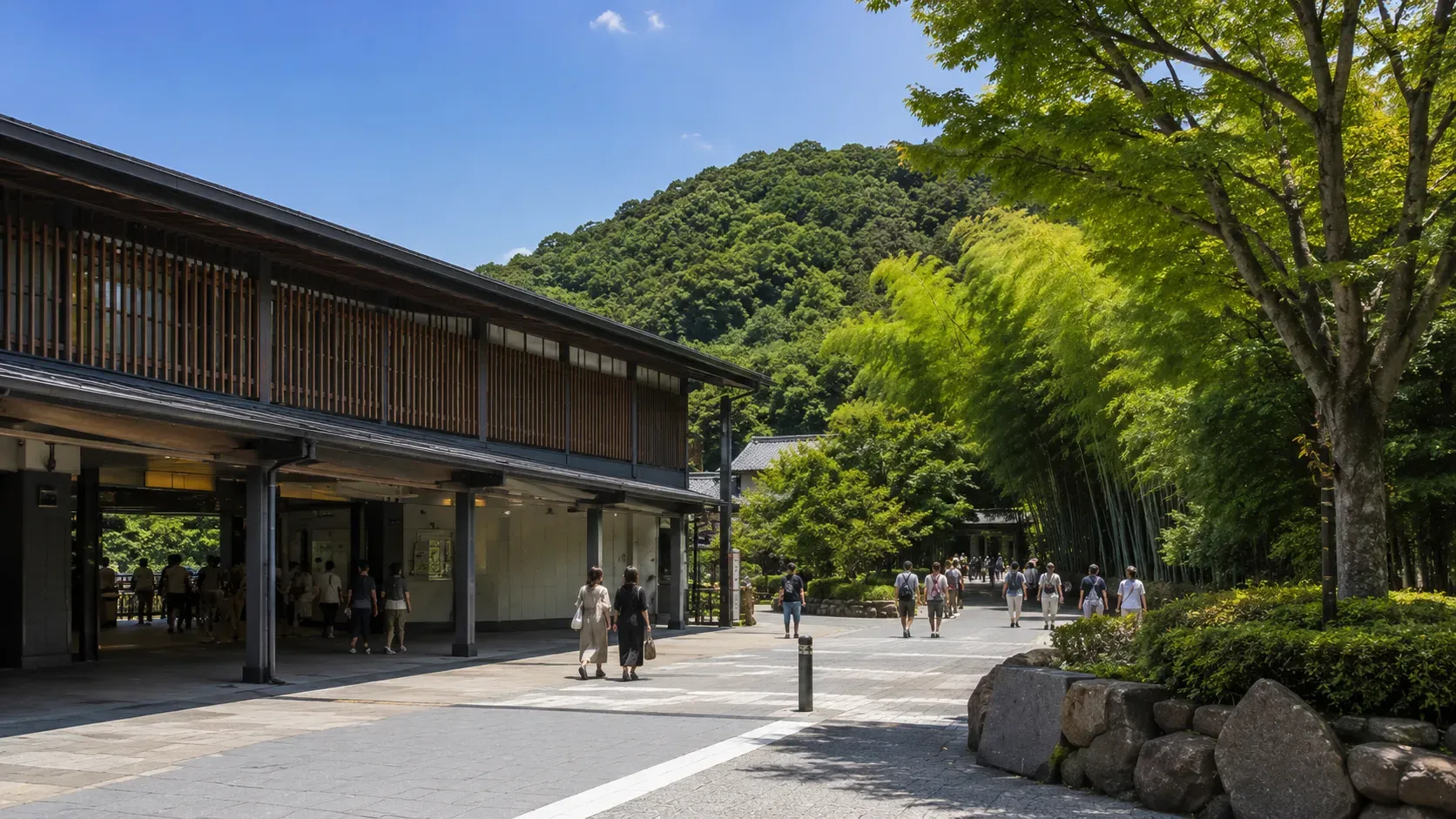
You can reach the Arashiyama Bamboo Grove, Japan, from central Kyoto by three different train lines. You don't need a car, and parking nearby is very limited.
- JR Sagano Line (most practical): Kyoto Station to Saga-Arashiyama Station; 15 to 20 minutes; fare ¥240; 10-minute walk to the grove entrance; JR Pass holders travel free on this route
- Randen Line (Keifuku Electric Railroad): Shijo Omiya Station to Randen Arashiyama Station; 25 minutes; retro tram experience; the station drops you directly into the Arashiyama tourist district
- Hankyu Line: From Hankyu Umeda Station (Osaka) to Hankyu Arashiyama Station; useful if you are coming from Osaka directly
The Sagano Scenic Railway (Torokko train) is a separate sightseeing option: an open-air vintage train running along the Hozu River gorge between Saga Torokko Station and Kameoka; the 25-minute ride costs ¥880 one-way and operates seasonally; advance reservation is strongly recommended.
What Can You Do Near the Arashiyama Bamboo Grove?
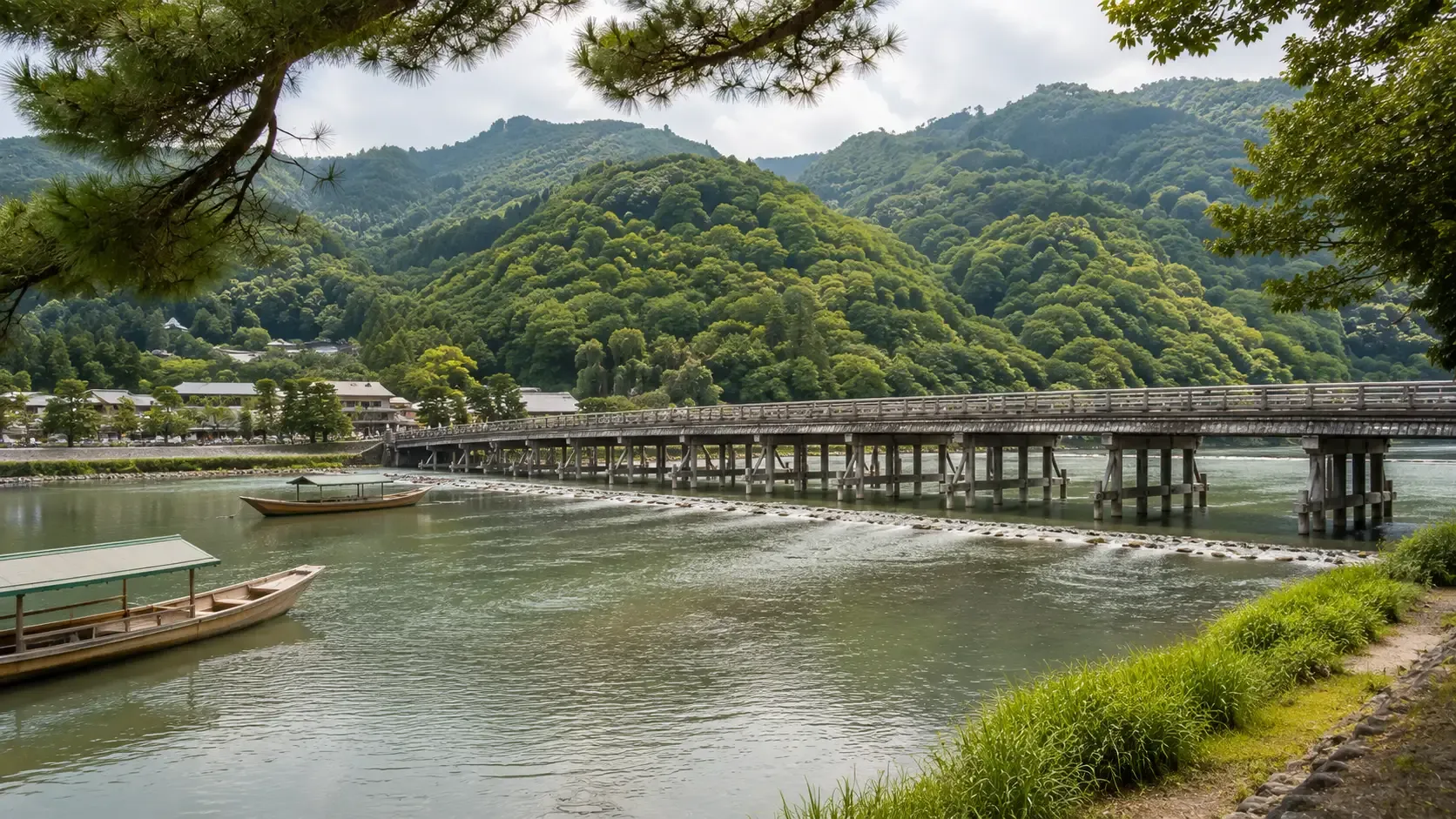
A relaxed walk through the Arashiyama Bamboo Grove takes 15 to 30 minutes. Most people also visit nearby attractions, making it easy to spend half a day or more in the Arashiyama district.
Attraction | Distance from Grove | Entry Fee | Time Needed |
Tenryu-ji Temple garden | Adjacent (1 min) | ¥500; Garden + temple buildings: ¥800 | 30 to 60 min |
Okochi Sanso Villa and Garden | 1 km north | ¥1,000 (includes matcha) | 45 to 60 min |
Togetsukyo Bridge | 15 min walk south | Free | 15 min |
Jojakko-ji Temple | 5 min walk | ¥500 | 30 min |
Hozugawa River Boat Ride | Starts in Kameoka | Paid; book in advance | 2 hours |
Sagano Scenic Railway | Saga Torokko Station (5 min walk) | ¥880 one-way | 25 min ride |
Tenryu-ji Temple is right next to the grove and is a UNESCO World Heritage Site with a beautiful pond garden that uses the surrounding hills as scenery. Okochi Sanso Villa is quieter and can be reached by a short walk through another bamboo path. You'll get the most out of the Arashiyama Bamboo Grove, Kyoto, district if you spend 3 to 5 hours there.
What Tips Should You Know Before Visiting?
- Arrive before 8am: The recommended Arashiyama Bamboo Grove timings for a quieter experience are to visit before 8am. The first JR trains leave Kyoto Station around 6am, so you'll have 30 to 45 minutes with fewer people on the path.
- The path is unlit at night: Even though the Arashiyama Bamboo Grove opening hours are 24 hours, there are no street lights along the way. It's best not to visit after dark.
- Wear comfortable shoes: Parts of the path are unpaved, with uneven stones and loose gravel in some spots.
- Carry cash: Some smaller attractions, food stalls, and rickshaw operators in Arashiyama may not accept cards, so be sure to have Japanese yen with you.
- The Arashiyama Bamboo Grove opening hours are 24/7, but nearby shops, cafes, and temples usually open from 9am to 5pm. Plan your visit if you want to see other sites too.
- You can find rickshaws near Togetsukyo Bridge. Make sure to agree on the fare and how long the ride will be before you get in.
Final Takeaway
The Arashiyama Bamboo Grove in Japan is free, always open, and one of Asia's most unique natural walks. Your experience depends on when you visit. Before 8am, it's quiet and peaceful, making the holiday from anywhere in Kyoto worthwhile. After 11am, it gets crowded.
For a full Arashiyama experience, visit the grove along with Tenryu-ji Temple garden and Okochi Sanso Villa. In the afternoon, add Togetsukyo Bridge for great mountain and river views.
If you're planning a holiday to Japan and want a custom itinerary with the best timing, places to stay, and sights to see, Holiday Tribe's travel advisors can help you plan your visit.